Overhead Storage
Overhead Garage Storage in Texas: What Not to Store Up There (and How to Maintain Your Racks)
By Iron Pecan Team · Published November 21, 2026 · Updated November 21, 2026 · 4 min read
On this page
In July, the air near the ceiling of a North Texas garage can get much hotter than the rest of the garage. Overhead racks are perfect for bulky, seasonal items, but some belongings should never go up there. An overhead garage storage Texas plan needs to consider heat, safe lifting and the load on the ceiling structure.
Before sorting your bins, check the capacity and storage instructions for your exact rack model. Do not assume that the same limit applies to every rack, or that a label guarantees the supporting framing can carry any load you choose.
Never store these items overhead
Paint, stain and aerosol cans. Product labels commonly call for controlled storage conditions. Heat can damage the contents or create pressure in a container. Keep these products in an appropriate location according to their label, not next to a hot garage ceiling.
Propane or fuel. Do not put fuel containers or propane cylinders on an indoor overhead rack. Follow the product and local safety requirements for ventilation, temperature and storage location.
Candles and crayons. They can soften or melt and leak onto other items. The same concern applies to temperature-sensitive craft materials.
Photos, documents and keepsakes. Heat and humidity can damage paper, finishes and adhesives. Store irreplaceable items in a climate-controlled part of the home.
Electronics, batteries and vinyl records. Excessive heat can damage components and warp materials. Batteries also require storage conditions specified by their manufacturer.
Heavy items used frequently. Even when an item is within the rack's rating, repeatedly lifting it from above your head may be unsafe. Everyday tools belong somewhere easier to reach.
Good candidates for overhead racks
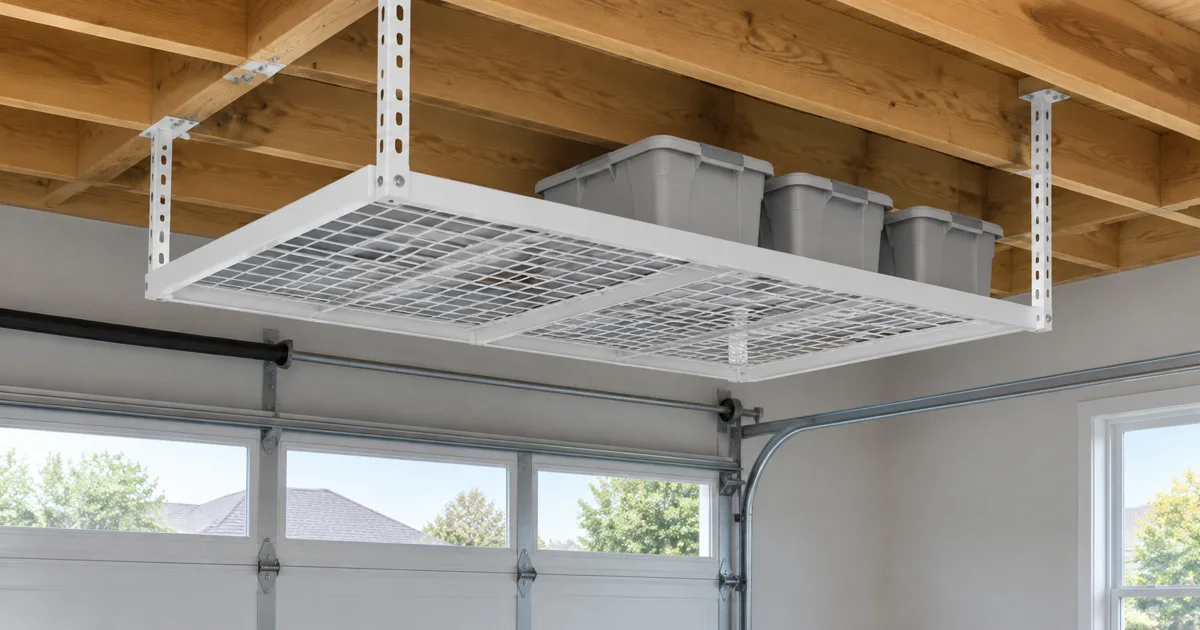
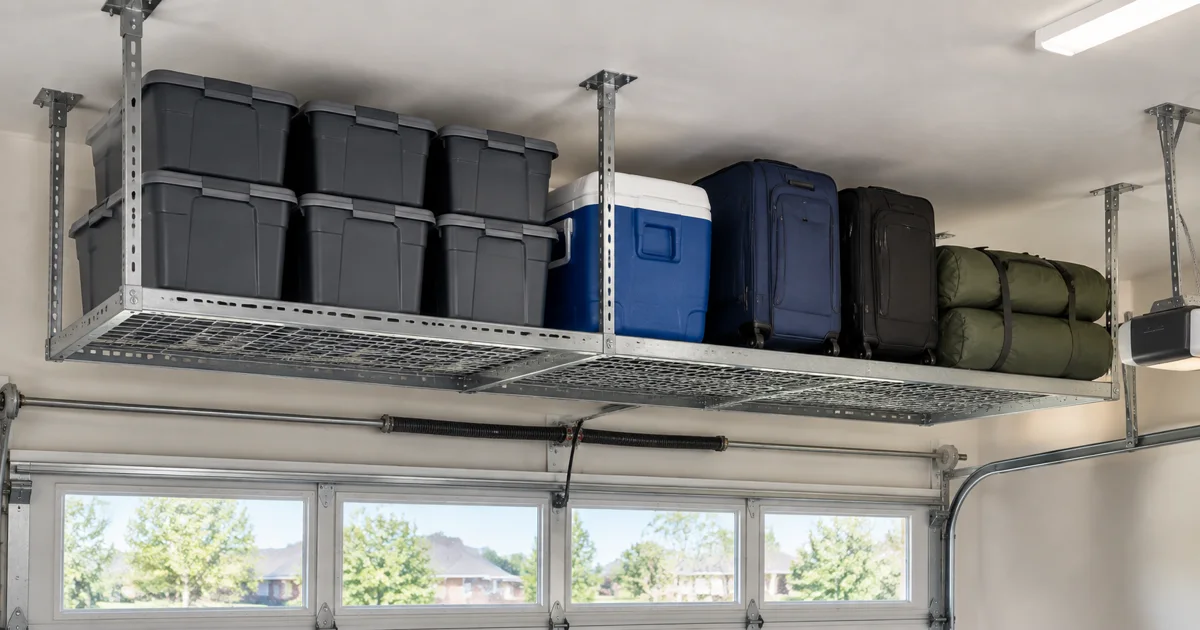
Holiday decorations in sealed bins, camping gear, coolers, luggage and seasonal sports equipment are often sensible candidates. Extra bedding in airtight bins or outgrown children's items may work if the material tolerates the garage environment.
Inspect items individually rather than treating an entire category as heat-proof. Remove batteries from stored equipment where the manufacturer recommends it, and move delicate fabrics or sentimental items indoors. Keep a simple inventory so you do not need to climb and search through every bin.
Load it the safe way
For an overhead garage storage Texas setup, use similar-size lidded bins with the labels facing outward. Distribute weight evenly and place heavier loads near supported edges or brackets as the rack manual directs, rather than concentrating everything in the center.
- Stay below the rated capacity and the verified capacity of the mounting structure.
- Account for the combined weight of all bins, not only the heaviest one.
- Never climb on the rack or hang from its rails.
- Leave room to lift a bin without catching it on framing or the ceiling.
- Keep the door, opener, lights and vehicle hatches clear.
Use a stable ladder and avoid leaning across a vehicle. If a bin is too heavy to handle safely, store it at ground-accessible height. A convenient rack should reduce clutter without introducing a difficult overhead lift.
Twice-a-year maintenance checklist
Check the rack at least twice a year and whenever you notice movement, noise or a change in clearance. Follow the manufacturer's inspection and tightening instructions; do not overtighten fasteners or repeatedly force a loose lag bolt into damaged wood.
- Inspect lag bolts, brackets and connecting hardware for looseness or damage.
- Look for bent rails, sagging decks and signs of shifting loads.
- Confirm that the rack is level and that the garage door clears it throughout travel.
- Dust and wipe the deck using the care instructions for the finish.
- Check bins for warping, cracks, heat damage or deteriorating lids.
- Revisit your inventory and remove products that should not be stored in heat.
Take heavy loads off a suspect rack before continuing to use it. Maintenance is not a reason to ignore structural damage or add a larger fastener without assessing the framing.
When to ask for professional help
Sagging, loose brackets, drywall cracks around mounting points or a rack that shifts are reasons to stop loading and have the installation assessed. Moving the rack to a new location also means rechecking joists, door clearances and the manufacturer’s requirements.
Iron Pecan installs racks you own: $150 for the first rack and $75 for each additional rack, for 4x8 racks on wood joists with ceilings up to 10 feet. Other cases are confirmed first, and you pay after installation.
Explore professional rack installation or request an installation estimate. For an anchoring overview, read our SafeRacks installation guide.